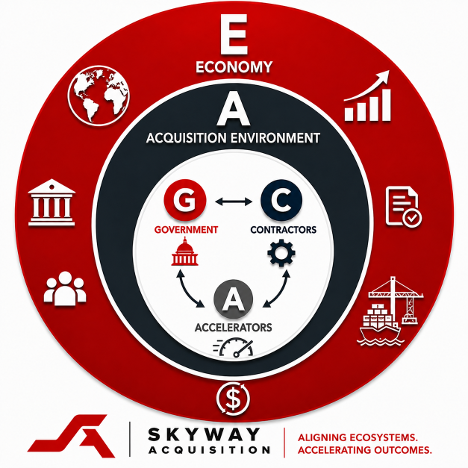
The Government awards contracts to a single legal entity. That usually is a single business entity but occasionally it can be to a joint venture or legally recognized business entity. The award to a single business entity allows the Government a single point of management of the contract. However, not every company has the requisite skills to deliver a product or service. Therefore, that company may need to subcontract work to other companies to provide the product or service.
The Government recognizes the need for these relationships, but it does not have a legal relationship with these subcontractors. The prime contractor retains legal and management responsibility for overall contract performance. There is privity of contract between the Government and the prime contractor, and between the prime contractor and their subcontractor(s). There is no privity of contract between the Government and the subcontractor. However, the Federal Acquisition Regulation and its supplements contain specific contract clauses that must “flow down” to subcontractors.
Most people think of the big defense contractors who make major weapon systems requiring hundreds of subsystems and thousands of parts using a multitude of tier subcontractors. For example, one of the largest major defense systems under contract for the Air Force, Navy, and Marines is the F-35 Joint Strike Fighter. Just for fun, there are three configurations, one for each service, and they do not share a 100% commonality across the three planes. It has an estimated two hundred subcontractors spread over forty-five states. Lockheed-Martin is the prime who must manage all subs and the parts to deliver the aircraft.
As a small contractor, you may think I don’t have those kinds of headaches, but even small businesses may have to subcontract under a federal contract. Let’s take a simple item like a screw. If you manufacture the screw, you still have to subcontract the material and a machine to make the screw. If you make enough screws, those subs may not be directly working your contract to deliver screws, but if the steel supplier is late, that could make you late on your contract. The Government will hold your company accountable for the late delivery.
The Government now contracts for multiple types of office services to supplement its workforce. In essence, the Government is subcontracting its requirement to deliver services to the people. A typical Government requirement for service may include specific skills and administrative support. An offeror may need to obtain people from another vendor to bid on the contract. That sets up a prime subcontract relationship.
The prime is responsible for managing the people on the contract. If they work for another company, then the prime must have procedures to deal with the subcontractors working on their contract. If the subcontractor fails to perform satisfactorily, the Government will look to the prime to resolve the matter. If the prime picks subcontractors poorly, it will reflect in a lower rating on the Contractor Performance Assessment Report System (CPARS).
For example, I had a logistic support contract that I was managing for a customer. The requirement was to scan technical documents and load them into an electronic storage system. There was a requirement to scan a fixed number of pages per month. The prime opted to subcontract a portion of that work. After six months, I got a call from the customer stating that the contractor had failed to scan the required number of pages for two consecutive months. I called the prime, who informed me that his sub was experiencing personnel issues, and that was why they had missed the delivery amount for the last two months. It took them two more months to get back on track. Despite their best efforts, the prime had to ask for an extension of two months to complete the work. When the CPARS was generated, the prime contested the satisfactory rating given by the Government, claiming that the prime fixed the problem with the sub. The Government position was that the contractor:
- Had failed to manage his sub and did not inform the Government of the problem until contacted and
- The contractor was late in completion.
The Government did not change the rating.
The use of subcontractors is essential, and I can cite multiple examples in the hardware and services contract types where these relationships worked well and where they caused problems. The key to this discussion for any company considering using a subcontractor is to develop a robust subcontract management process and understand that the Government is holding the prime responsible for all performance issues.